|
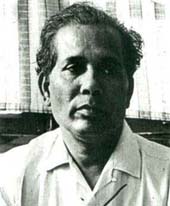
Born in 1917,
Kishoreganj, Bangladesh
Zainul Abedin's first memories are centered
round unsophisticated life and landscapes,
enlivened by the quite-flowing Brahmaputra
river, majestically winding its way through
idyllic, pastoral countryside.
It was this simple beauty, with the sad
introspection and certain tragic quality
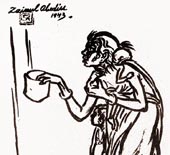
about it, which he later deftly captured
in the scaffolding of his brisk, bold and
strong lines and his soft, glistening water
colors.
His father was Police Officer and as he
went on transfer from one district to another,
young Abedin came to adore the green, reverie
countryside marked by tall, graceful palm
trees and coconut groves. Occasional hills
and dales broke the monotony of alluvial
plains, as in Sherpur, near the picturesque
Garo Hills, where he had his first taste
of primary school. Instead of sums, however,
he filled his copybook with hieroglyphs,
which he himself did not very well understand.
His increasing interest in art, however
was much to dislike of his parents, who
naturally wanted him to shape as police
officer! He was constantly scolded and admonished.
Then, one evening, he ran away from his
home with children's poem book of the banks
of his favorite Brahmaputra river.
There it lay, as far has he could see, nestling
in the expansive countryside landscape,
turning it into green carpet of miles of
paddy fields. In front of him and all around
him was bounteous nature spreading its arms.
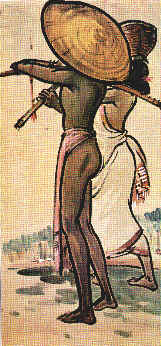
On the river were shining boatmen. In the
fields worked women, with their graceful
figure almost bare, ebonises by the vagaries
of life in the open ,beaten by sun and rain.
For the next many weeks, he roamed about
from village to village, living with farmers
and boatmen and working with them, occasionally
using indigenous charcoal for sketches and
illustrations that filled his book of poems.
Months later, when this illustrated, and,
of course, very much faded book of poems
reached his headmaster, he was greatly impressed
and persuaded disappointed father to send
the young boy to Calcutta for proper art
education.
Life in Calcutta was difficult and friendless
in the beginning, but it had its own compensations.
In 1938, he received the Diploma of Fine
Arts from Calcutta Art School and was immediately
offered a teaching job at the same institution.
He taught as well as painted, exhibiting
his work and winning several prizes for
amateur work in Art Exhibitions in the country,
as well as abroad.
In 1951, he visited London and later traveled
widely over Europe. The whole body of his
works have be seen in individual exhibitions
in European capitals.
Zainul Abedin, painter as well as teacher,
is himself the founder and leading artist
of what has come to "Dacca Art Group".
He was also the principal of Government
Art Institute, Dacca, East Pakistan (now
Bangladesh). His paintings and drawings
have been widely seen and admired in composite
exhibitions by UNESCO and various international
bodies, as well as group exhibitions in
Europe, Turkey, Japan, Mexico and USA.
Zainul Abedin has painted extensively in
wide variety of styles, ranging from purely
objective and almost photographic to various
abstract and semi-abstract studies. He was
very interested in Japanese painting style.
Ref: http://www.caroun.com/Painting/
|